 Charles
Dockum
(1904-1977)
Charles
Dockum
(1904-1977)
Charles
Dockum
(1904-1977)
NEWS: We are sad to share the news that Charles Dockum's Altadena Dockum Research Lab burned down during the LA fires. The building contained his archive of his Mobilcolor work, and his last Mobilcolor Projector. Some of his correspondence and diagrams are in the archive at Guggenheim NY; at CVM we have some papers, photographs and all of his films. We'll post more photos in the near future. An excerpt from Dockum's 1966 documentary film about his Mobilcolor is here (see below for more film documentation). See below for info re donating to digitize more of his films.
Biography
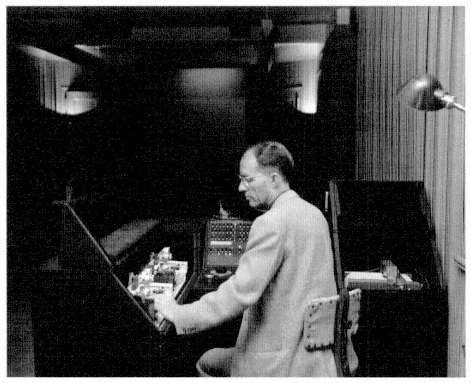
Charles Dockum was born in Texas in 1904, and earned a degree in electrical engineering at Texas A & M in 1926. His health required him to move to Arizona, where he began working on the production of projection machinery that could perform color abstract imagery moving in a harmony and counterpoint comparable to auditory music. He coined the term Mobilcolor for this new artform, and gave public performances in 1936 in Prescott, Arizona. He became well enough to move to California shortly thereafter, and he continued working on improved MobilColor projectors (he would make six models altogether) at his home in the Los Angeles suburb of Altadena. Dockum enjoyed successful performances at such places as the Pasadena Playhouse and the California Institute of Technology. In 1942, the Baroness Hilla Rebay awarded him a fellowship from the Guggenheim Foundation to build a new improved MobilColor projector that could be installed at the Guggenheim Museum. By 1950, Dockum had perfected the MobilColor IV, which could produce layered movements of diverse over-lapping imagery. Dockum built MobilColor V in the early 1960s, and continued to perform at various venues in California. The MobilColor VI remained unfinished at Dockum's death in 1977. (William Moritz)
-------------
From MOBILCOLOR, a Dockum Research Laboratory brochure: "About the Inventor"
Charles Dockum was born in Corsicana, Texas, in 1904. He obtained a degree in electrical engineering at Texas A & M in 1926. Immediately thereafter began his intense interest in art, particularly in composition employing the functional use of form and color as conceived in the contemporary movement in painting and architecture.
In 1935 he began the first experiments toward the development of Light Projection (MOBILCOLOR) as a fine art, combining a knowledge of music and the graphic arts with his previous training in electrical and illumination engineering. Several years later Color Concerts were given at Cal Tech and the Pasadena Playhouse.
Solomon R. Guggenheim recognized the importance of this work in 1942 and furnished generous funding for the following ten years. Mr. Guggenheim planned to establish an Institute of Light with the Dockum MOBILCOLOR Instrument at its center. His aims were, first, to present Color Concerts, and second, to furnish training for students and artists in composing with colored light.
Due to the death of Mr. Guggenheim and the loss of his funding, MOBILCOLOR was dormant until 1960, when the artist-inventor again started development of his own projection instrument in his studio at the Dockum Research Laboratory in Altadena, California. Beginning in 1971, Color Concerts were given at Cal State College, Hayward, and at Ramo Auditorium at Cal Tech, while continuous private showing were held at the studio. These included several series of Color Shows for surrounding colleges as well as single performances for many interested groups.
Currently, MOBILCOLOR VI is being designed to utilize a mini-computer as part of its composing and performing systems. Charles Dockum died in June, 1977, but his new concept of visual art and the development of color symphonies is continually going forward. (published by the Dockum Research Lab shortly after Dockum's death).
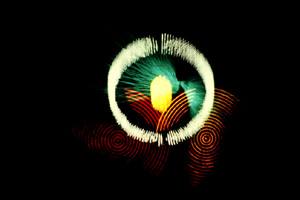
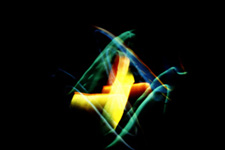
About Mobilcolor
Dockum, Charles:
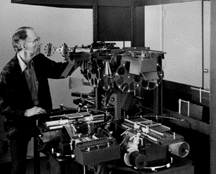
The Dockum system of Mobilcolor Projection differs from previous efforts in this field in its practical means of generating mobile form elements, and in the sensitive and accurate control of these mobile forms of light toward the production of a logical and moving thematic development, analogous to the manner in which musical themes are composed into structural forms known as sonatas, fugues, symphonies, etc. Without such control no system can hope to meet the requirements of a great Art and hold a wide, sustained interest among composers, critics and the public. This system also provides a means of recording these visual compositions so that a permanent record remains of any composer's work, which can then be reproduced exactly as created. (Dockum Research Lab brochure).
at The Guggenheim, New York
Program Notes. These were given to visitors attending Mobilcolor Concerts, providing brief descriptions of the compositions. (Courtesy Dockum Research Laboratory).
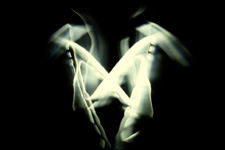
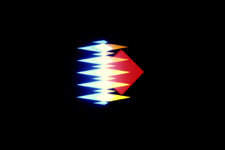
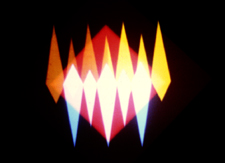
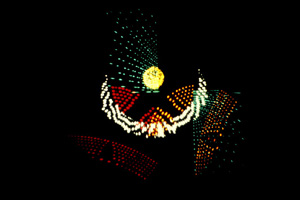
GEOMETRICS: Sharply defined shapes develop rhythmically with emphasis on theme and variation. New colors are formed by the additive process of color mixing, unique to the medium of light.
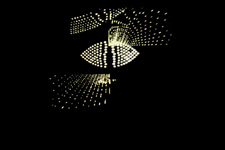
SPARKLETTS: Forms are made up of scintillating points of light. The use of varying light intensities causes the forms to come forth or recede in space, thus assuming a primary or secondary role in the composition.
YARDS AND YARDS: A three-dimensional quality is produced by a special treatment of the objective lenses.
IMPROVISATIONS: Manual and mechanical manipulations demonstrate the versatility and artistic possibilities of MOBILCOLOR, and how an artist would compose in colored light.
Mobilcolor II, 1942
Charts and Scores
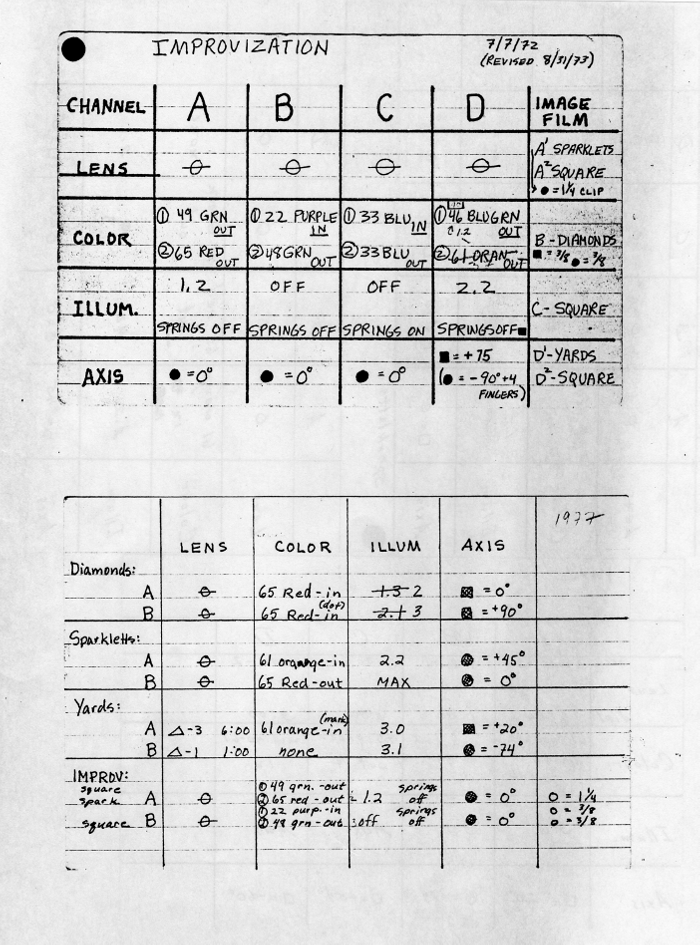
1972-73 Chart for Improvization
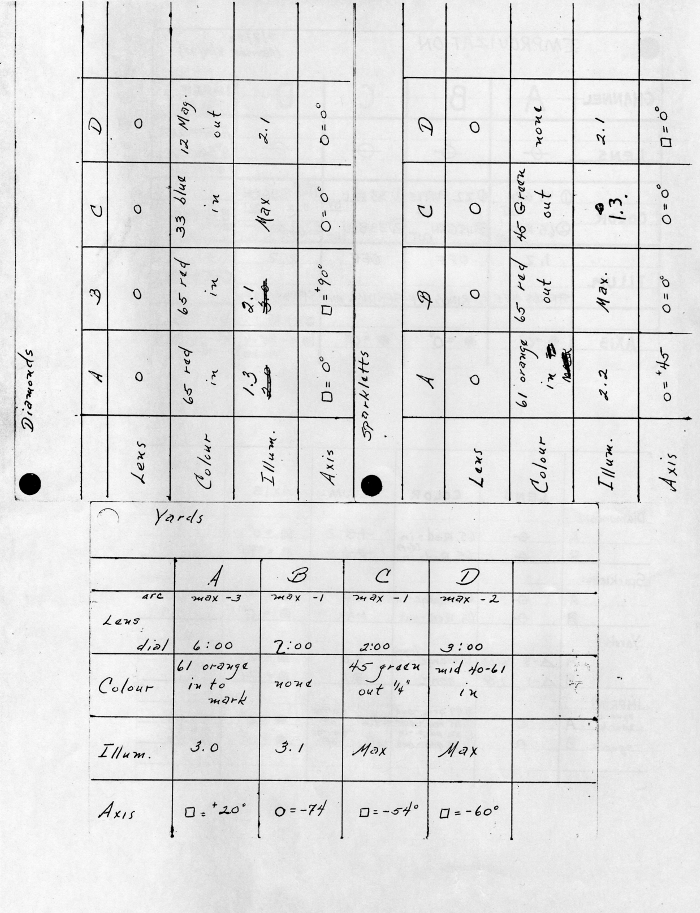
Charts for Diamonds, Sparketts, Yards
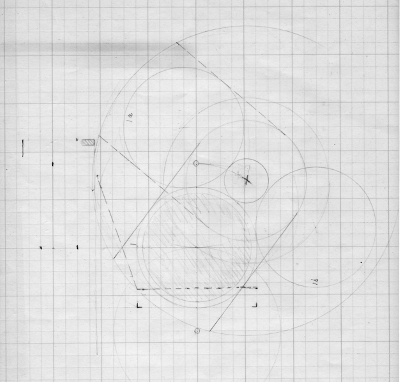
Diagram for one of Dockum's color wheels
Press
De Groat, Charles. Charles Dockum's 'Light Show' Unlike Anything Offered Before. Star-News (Pasadena)
Keefer, Cindy. Expanded Abstraction, on the LACMA Unframed Blog, January 2012
Film Documentation
NEWS: Three restored Charles Dockum Mobilcolor films were released on CVM's DVD, Visual Music 1947-1986 from CVM Archive. Full title list and details here. You can also order through our Squarespace store. An excerpt from Dockum's 1966 documentary film is here.
CVM has been preserving Dockum's films. Several have been completed (photochemical restoration) including a 1966 documentary by Dockum, and performance films from 1952, 1966, 1969 and 1970. Some still need digitization. We have a few trailers on vimeo; for research access to view the films please contact us, or view on the above mentioned DVD. For bookings of his films please also contact Center for Visual Music (email at bottom of page). If you'd like to help with the digitization of more of his work, please contact us or DONATE through the link at bottom of this page, or via button on our home page, www.centerforvisualmusic.org/
Currently his 1952 Mobilcolor Performance film is part of an exhibition at Palm Springs Museum of Art (as of Jan 2025).
An excerpt from Dockum's 1952 Mobilcolor Performance at the Guggenheim film, preserved by Center for Visual Music from the 16mm camera original (shot by Ted Nemeth), screened in the Visual Music exhibition at MOCA Los Angeles (2005) and The Hirshhorn Museum, Washington, D.C. (2005). This film also screened at The Guggenheim Museum, New York, in 2005, accompanying their Hilla Rebay exhibition; in CVM's film series at The Guggenheim in 2010 accompanyiing a Kandinsky exhibition, at various other festivals internationally, and at The Hammer Museum, Los Angeles in 2009. This film and 2 others about Dockum's work travel in CVM's Essential Visual Music: Rare Classics film program, which has screened in the US and Australia. Other Dockum films were screened by CVM at the International Film Festival Rotterdam, and LACMA, Los Angeles. In recent years CVM has loaned restored versions of his films (digital) to institutions including ZKM, Karlsruhe, Germany.The 1969 Mobilcolor film screened at LACMA for six months, beginning August 2011, and was screened in Amsterdam at the Sonic Acts Festival, 2012. A note from the Amsterdam curator Joost Rekveld:
The Dockum film is GORGEOUS ! The audience was in a collective trance in especially the first, geometric section... The movements are very very very beautiful indeed. And even when I have a rough understanding of how his projector works, in this case I can't figure out how he could do this live. Amazing. The last and middle sections are great too. (Rekveld)
Selected Correspondence
Letter, Charles Dockum to Frank Lloyd Wright, June 10, 1944. Unpublished. Excerpt:
The Projector makes use of two groups of celluloid films, 4-1/4" wide, the three films of each group being superimposed before a projection aperture. By means of a seventh, control film, the films in each aperture group can be made to move either up or down, change speed or pause before the aperture. By this means designs carried on the films are made to modify each other as desired and produce rhythmic movements and effects over a wide range. The control film also governs the intensity of illumination. Special lens arrangements give the projections a luminous, prismatic quality.
The designs on the films are not drawn or painted on in the sense of painting a picture, as in animated cinematography. Rather the mathematical proportions are worked out which will give the desired results, and the films then opaqued to leave transparent "windows" which allow shafts or areas of light to pass through in guided movement.
Selected Performances
February 12, 1936. "An Evening of Modern Art." The Monday Club, Prescott, Arizona.
June 17, 1942. The Museum of Non-Objective Painting, New York, NY (MoNO press release)
1952. Solomon R. Guggenheim Museum, New York, NY
Feb-March 1969 (7 performances). Arcadia Community Theatre - "Special 'Mobil-Color optical film effects created by Charles Dockum Research Labs."
c. 1971. Cal Tech, Pasadena.
Bibliography
Brougher, Kerry et al. Visual Music: Synaesthesia in Art and Music Since 1900 (New York: Thames and Hudson, 2005). Ex.Cat.
Haller, Robert. "Charles Dockum" in First Light (New York: Anthology Film Archives). Ex. Cat.
Levin, Golan. Painterly Interfaces for Audiovisual Performance. Thesis submitted to MIT, 2000.
Lukach, Joan M. Hilla Rebay: In Search of the Spiritual in Art. (New York: George Braziller, 1983). contains errata
Keefer, Cindy. "Space Light Art" - Early Abstract Cinema and Multimedia, 1900-1959. in White Noise. Ernest Edmonds, Ed. Melbourne: Australian Centre for the Moving Image, 2005. Ex. Cat.
Moritz, Dr. William
-- The Dream of Color Music, and Machines That Made it Possible in Animation World Magazine, 2.1, April 1997 (excerpt, contains errata).
-- "Visual Music and Film-As-An-Art Before 1950" in On the Edge of America: California Modernist Art, 1900-1950. Karlstrom, Paul J., Ed. Berkeley: University of California Press, 1996.
-- Abstract Film and Color Music in The Spiritual in Art: Abstract Painting 1890-1985. (Los Angeles: Abbeville Press, 1986). LACMA exhibition catalog (excerpt online).
-- Towards an Aesthetics of Visual Music in ASIFA Canada Bulletin, Dec 1986.
--"Towards a Visual Music" in Cantrill's Filmnotes, 1985. Excerpt: "...the special intensities and subtleties of live light cause others, like Charles Dockum (1904-1977) to devote over 40 years to the perfection of his fine Mobilcolor Projector, a classic example of the plight of the color organ. The Mobilcolor, a large, complex mechanism, requires two people to operate it for an elaborate composition - but the resultant spectacle is definitely worth it. The imagery can be hard-edged or amorphous, and can be programmed to move at specific speeds in smooth, definite patterns. The wide range of controlled light intensity, with several (overlapping) sources, offers a visual delicacy that can not be reproduced on film or video."
Smith, Steven A., Greta J. Dockum, and Gretchen Evans Dockum. "Kinetic Art: The Mobilcolor Projectors of Charles R. Dockum (1904-1977). Leonardo 12 (1979), pp 144-50.
Vail, Karole, Ed. The Museum of Non-Objective Painting. New York: Guggenheim Museum, 2009.
Zuvela, Danni. The Musicality of the Moving Image. RealTime Arts, No. 85 (June-July 2008). Brisbane, Australia.
PLEASE HELP SUPPORT CVM's WORK: Donate online here (you do not need a paypal account). CVM is a 501(c) 3 nonprofit.
You can also Support CVM by becoming a Member. Membership benefits include our members-only discussion list, and cool vintage Fischinger, Moritz, Whitney premiums: posters, cards, books, dvds. Learn more or join here.
For Bookings of Dockum's films contact CVMaccess (at) gmail.com
Photographs (c) Greta Dockum/Estate of Charles Dockum and Center for Visual Music. Film stills created by and courtesy Center for Visual Music. All rights reserved.